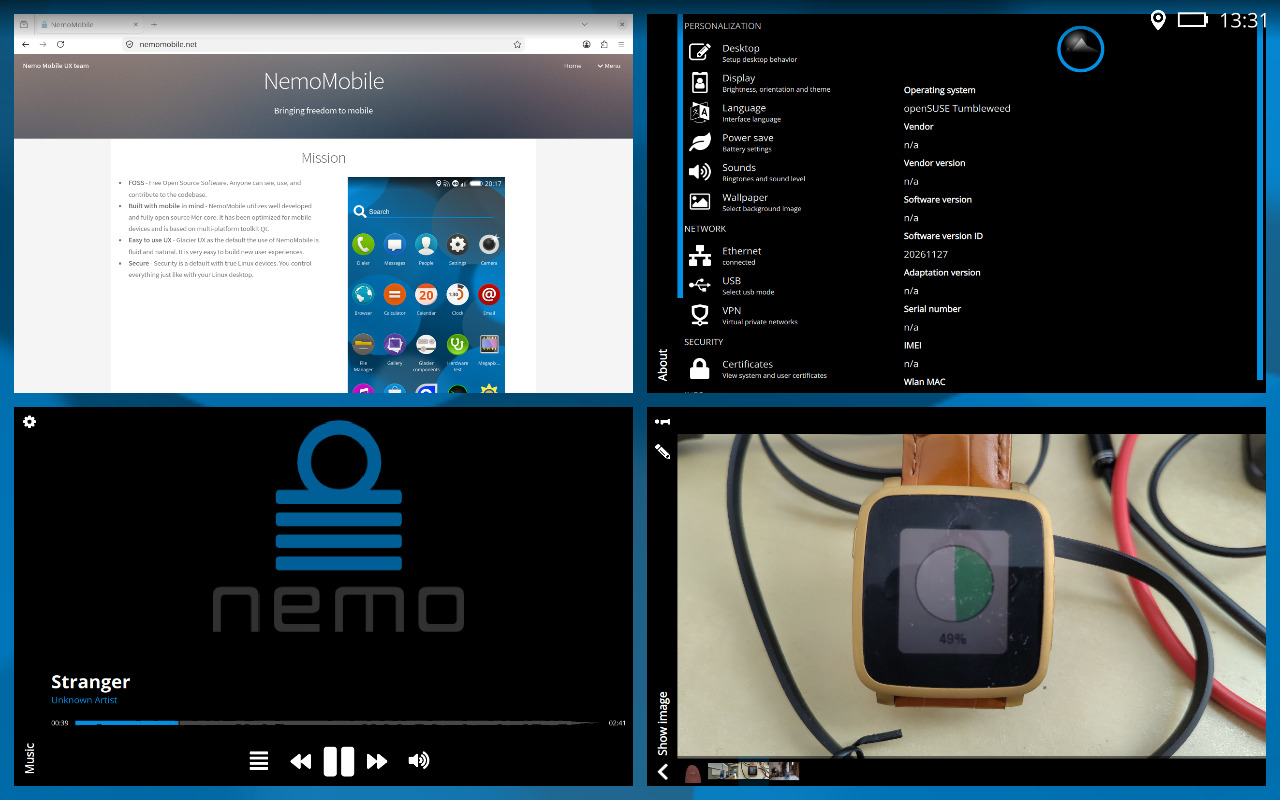
Nemomobile in 2026
Most of 2026 went into making the base system complete on openSUSE. Nemo got its own replacements for OHM and GeoClue, a first-boot wizard, a package manager with several backends, a working camera with HDR, and a large round of fixes and tests in Lipstick and Qt Quick Controls Nemo.
openSUSE and OBS
The move to openSUSE continues. The devel:NemoMobile project on OBS now builds the whole stack, and images for the PinePhone, the PineTab, and x86_64 virtual machines are available in the image repository. The installation page was updated with instructions for these images.
New packages were added to OBS: glacier-welcome, glacier-packagemanager, glacier-settings-accounts,
glacier-camera, glacier-music, kremnium, locationd, and resourced. The nemo-device-efi and
nemo-device-x86_64-efi packages hold the device configuration for generic EFI machines. The old Manjaro image
pipeline was disabled.
Glacier Welcome
Glacier Welcome is now a complete first-boot wizard. After the welcome screen, it asks for the language, connects to a network (the Wi-Fi password is entered directly on the page), and sets the date, the time, and the time zone. The last step sets the device lock code. The service runs before Lipstick only until the setup is done.
resourced replaces OHM
resourced is a new implementation of the resource manager daemon in Qt 6.
It replaces the old OHM-based resource manager, without Prolog and other heavy dependencies. It keeps the
org.maemo.resource.manager D-Bus protocol, so applications using libresource work as before. It supports
priorities and preemption, shared resources, and cleanup when a client disconnects. It comes with unit tests.
locationd replaces GeoClue
locationd, introduced in the last post, was finished. It provides the GeoClue 1 D-Bus API, with an optional GeoClue 2 compatibility layer, and it works with the Qt Positioning plugin. Location data comes from plugins: GPS (NMEA over a serial device), GeoIP, oFono (cellular), and Wi-Fi. The GPS provider is offered only after a valid fix, a passive provider returns cached positions, and GeoIP is refreshed when the network changes.
Applications now need permission to read the location. An
authorization agent
asks the user with a notification, and trusted applications can be allowed in advance in an allowlist.d folder.
Glacier Settings starts positioning only when it is available and enabled.
Package manager
Glacier Package Manager was originally written for Manjaro. It now has a plugin API with optional backends for APT, RPM (through libzypp), Snap, and Flatpak, and several backends can be used at the same time. A new page manages the software repositories.
Other applications can use the package manager through a D-Bus interface. For example, Glacier Home now offers an uninstall menu for applications. Updates are checked by a systemd timer, which respects the update connection setting. The package manager settings moved from Glacier Settings into the package manager itself.
Applications
Glacier Camera now uses libcamera through Qt Multimedia. It can take HDR photos: it captures a bracket of exposures and merges them in software, and an HDR+ plugin processes bursts. Photos now contain EXIF metadata.
Glacier Music got plugins for loudness normalization and for looking up tags with AcoustID. It remembers the current track and position, and many crashes and memory leaks were fixed.
Glacier Gallery was ported from QtDocGallery to Tracker 3.
Glacier Settings has new plugins for VPN, Ethernet, the keypad, and certificates, and it got faster thanks to caching of plugins, time zones, and themes. Glacier Settings Accounts was ported to Qt 6. nemo-qml-plugin-systemsettings was synced with the Sailfish OS upstream.
Kremnium
Kremnium, the compatibility layer for Sailfish OS applications, got a large round of work. Page stack navigation and animations, edge-swipe back navigation, context menus in list items, remorse items, notices, and better text fields, sliders, and combo boxes were added. The Silica component gallery and the test applications now run on Kremnium.
Lipstick and Glacier Home
Lipstick implements the Wayland viewporter and fractional scaling protocols, popups, and maximized windows. The screen recorder was ported to Qt 6, and keymaps are supported. Lipstick no longer uses GLib, and volume control moved to the current PulseAudio API. All unit tests pass again with Qt 6, and a new test covers the real compositor. Fixes from the Sailfish OS upstream were merged as well.
Glacier Home can run in a window
with --desktop or --app, which makes development on a desktop computer easier. The compositor gestures got
several fixes for crashes and memory leaks.
Qt Quick Controls Nemo
The controls can now be used with a keyboard. In portrait mode, the main menu is hidden and the content is shown. Text fields have a touch context menu and selection handles. The Nemo icon was reworked, and the test suite, started in summer 2025, now runs as part of the build. Around 40 fixes for memory leaks, bindings, and layouts went in. libglacierapp dropped Qt 5 support.